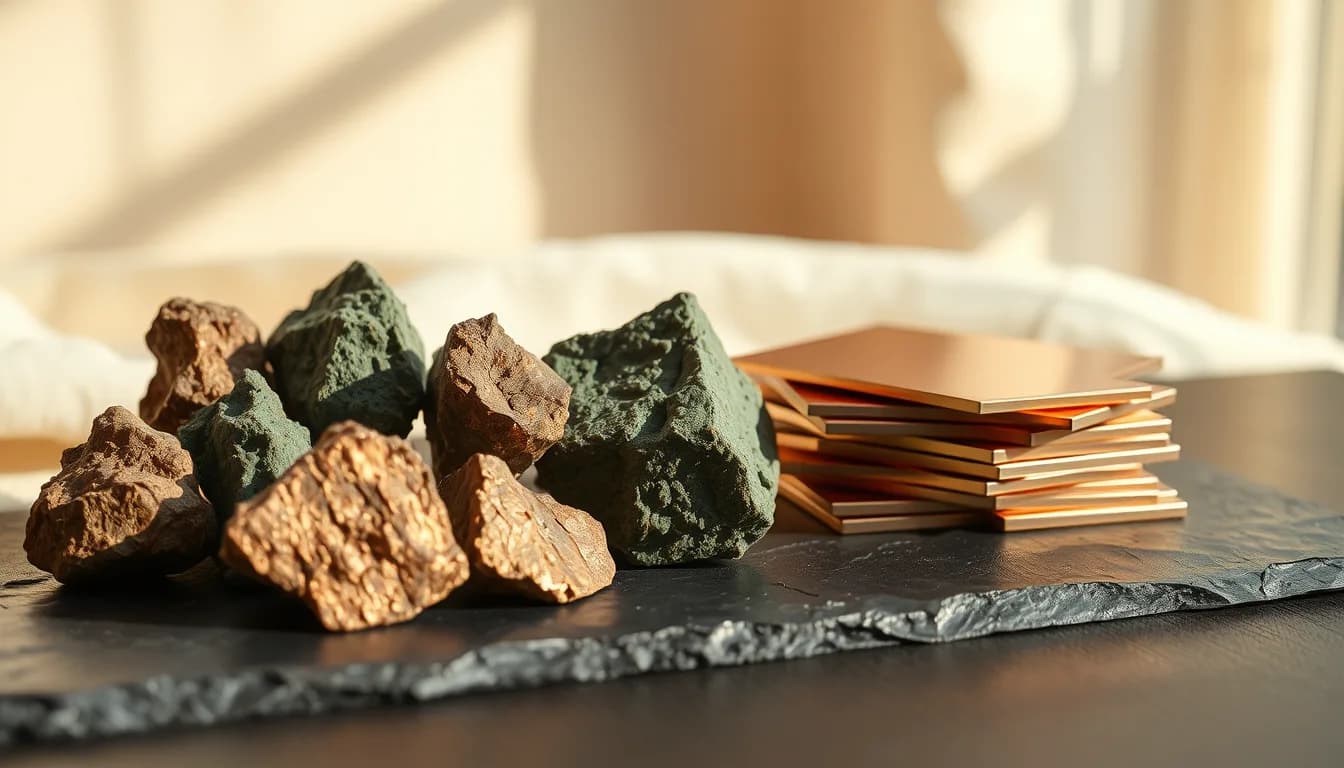
Copper stocks are shares of companies that mine, explore for, or earn royalties from copper. They usually move two to three times as much as the copper price itself, in both directions, and carry company and country risks that the metal does not. Copper miner ETFs spread that risk across dozens of producers.
The number that matters: a copper miner's share price typically swings two to three times as much as the copper price itself. That leverage is the entire appeal of copper stocks, and the entire risk.
If you want copper exposure, you have three basic routes: own the companies (stocks), own a basket of the companies (miner ETFs), or track the metal through futures (commodity funds). This guide explains how each one behaves, where the hidden risks sit, and how to judge them yourself. It is not a list of picks.
For the metal itself, check the live copper price first. Everything below is tied to that number.
First, a quick definitions check
"Copper stocks" means two different things depending on who is talking.
- To investors, it means equities: shares of copper mining, exploration and royalty companies.
- To metal traders, it means physical inventories, the tonnes of copper sitting in warehouses tracked by the LME, COMEX and the Shanghai Futures Exchange.
The two are connected. Falling exchange inventories usually signal tight supply, which tends to support the copper price, which tends to lift mining shares. This page is about the equities, but inventory data is worth watching if you own them.
Why copper miners move more than copper
Miners have high fixed costs. Once a mine is built, staffing, energy, equipment and debt payments run whether copper is cheap or expensive. So profit is the gap between the copper price and the cost of production, and that gap moves much faster than the price.
A hypothetical example, using round numbers rather than today's market:
| Scenario | Copper price | All-in cost | Margin per lb | Change in margin |
|---|---|---|---|---|
| Starting point | $4.50/lb | $3.00/lb | $1.50 | — |
| Copper up 20% | $5.40/lb | $3.00/lb | $2.40 | +60% |
| Copper down 20% | $3.60/lb | $3.00/lb | $0.60 | −60% |
A 20% move in the metal produced a 60% move in profit margin. Share prices do not follow margins one-for-one, but this is why the miners amplify the commodity.
Two details follow from this:
- High-cost miners have more leverage. A producer with a $4.00 cost base sees its margin balloon when copper rallies, and disappear when it falls. Low-cost producers are steadier.
- The leverage is asymmetric over time. Costs tend to creep up (wages, energy, lower ore grades), so a flat copper price can mean shrinking profits.
This is the same dynamic covered in our guide to gold stocks vs physical gold. Copper miners just tend to be even more cyclical, because copper demand is tied to construction, manufacturing and electrification rather than safe-haven buying.
The main types of copper stocks
Not all copper companies are the same bet. Here is how the categories compare.
| Type | What it is | How it tracks copper | Typical volatility | Dividends | Main risks |
|---|---|---|---|---|---|
| Major pure-play producers | Large companies where copper is most of revenue (e.g., Freeport-McMoRan, Southern Copper) | Closely, with 2–3× leverage | High | Often, variable | Single-mine outages, country risk, cost inflation |
| Diversified miners | Giants producing copper alongside iron ore, coal, nickel and more (e.g., BHP, Glencore, Rio Tinto) | Partially; copper is one segment | Moderate | Usually | Other commodities can dominate results |
| Mid-tier producers | One to a few operating mines | Closely, often more leveraged | High to very high | Sometimes | Concentration in one asset or country |
| Developers | Building a mine, not yet producing | Loosely; driven by financing and permits | Very high | Rarely | Construction overruns, dilution, permitting |
| Juniors / explorers | Searching for deposits | Weakly; driven by drill results | Extreme | No | Most never become mines |
| Royalty and streaming firms | Fund mines in exchange for a cut of output or revenue | Moderately, with lower cost exposure | Lower than miners | Often | Limited pure-copper options; depend on operators |
| Copper miner ETFs | Baskets of 30–60+ copper companies | Closely, as a sector | High | Pass-through | Sector-wide downturns, fees |
| Copper futures funds | Hold COMEX copper futures, not companies | Directly, minus roll costs | Copper's own volatility | No | Futures roll costs, tax complexity |
Majors vs juniors in plain terms
A major is a business. It has revenue, cash flow, a balance sheet and analysts covering it. Its share price mostly reflects the copper price, production volumes and costs.
A junior is a hypothesis. It has a deposit (maybe), a drill program, and a need to raise money, often by issuing new shares that dilute existing holders. Junior stocks can multiply on a good drill result or lose most of their value on a bad one, almost regardless of what copper does. Industry estimates commonly put the odds of an exploration discovery becoming a producing mine at well under 1 in 100, and the path from discovery to production often takes 10 to 20 years.
One quirk worth knowing: some of the world's biggest copper producers are not investable. Chile's Codelco, a top producer for decades, is state-owned. Others trade mainly in London, Toronto or Sydney, which matters if your US brokerage has limited foreign access (many trade in the US as ADRs or OTC listings).
Royalty and streaming companies
Royalty firms pay a mine operator upfront in exchange for a percentage of future revenue or a share of production at a fixed low price. They do not run mines, so they avoid most cost inflation and operating headaches.
The catch: most large royalty companies are gold-focused. Copper exposure often comes indirectly, through streams on gold or silver produced as a by-product of copper mines. If you want royalty-style copper exposure, read a company's revenue breakdown to see how much actually comes from copper.
Copper miner ETFs
For most people who want the sector rather than a single company, an ETF is the simplest route. A few widely followed US-listed funds:
| Fund (ticker) | What it holds | Notes |
|---|---|---|
| Global X Copper Miners ETF (COPX) | Broad basket of global copper miners | Largest and oldest of the group; 0.65% expense ratio |
| Sprott Copper Miners ETF (COPP) | Copper-focused miners | Newer, more concentrated in pure plays |
| Sprott Junior Copper Miners ETF (COPJ) | Small and mid-sized copper companies | Higher volatility by design |
| Themes Copper Miners ETF (COPA) | Tracks a copper mining index of ~50 companies | Lower-cost newer entrant |
| United States Copper Index Fund (CPER) | COMEX copper futures, not stocks | Tracks the metal, not the miners |
Before buying any of these, check three things on the fund's own page:
- Expense ratio. Fees compound. A 0.65% fee costs $65 a year per $10,000.
- Top holdings and concentration. Some funds put a large share in the top 10 names. Check whether diversified giants like BHP dilute the copper exposure you think you are buying.
- Country breakdown. Many copper ETFs are heavily weighted toward Canada-listed companies with mines in Latin America and Africa.
CPER deserves its own warning. It holds futures contracts and must "roll" them as they expire. When later-dated contracts cost more than near-dated ones, that roll quietly erodes returns over time. Futures funds also often carry different tax treatment and paperwork than ordinary ETFs, so check the fund's tax documents before you buy.
What actually drives copper stocks
Copper earned the nickname "Dr. Copper" because its price tends to reflect global economic health. The main drivers:
- China. It consumes roughly half the world's copper. Chinese property, manufacturing and stimulus news can move the whole sector in a day.
- Electrification. EVs, power grids, data centers and renewable energy all use substantial amounts of copper. This is the long-term demand case most bulls cite.
- Supply constraints. Ore grades at older mines are declining, and new mines take a decade or more to permit and build.
- The US dollar. Copper is priced in dollars; a stronger dollar tends to pressure commodity prices.
- Interest rates. Mining is capital-intensive. Higher rates raise financing costs and lower the present value of long-dated projects.
- Recession risk. When growth fears rise, copper and its miners usually fall together, often harder than the broad market.
The macro forces overlap with those behind gold, though copper reacts to growth while gold reacts more to fear and real yields. Our explainer on why gold is moving covers the rate and dollar side in more detail.
Risks that the copper price won't show you
Owning a miner means owning risks the metal does not have.
- Jurisdiction risk. Governments can raise royalties, rewrite contracts or shut mines. In late 2023, Panama's Supreme Court ruled First Quantum's Cobre Panamá contract unconstitutional, and the mine, one of the world's newer large copper operations, was halted. The stock fell sharply in weeks.
- Operational risk. Floods, accidents, strikes, power shortages and equipment failures can cut production at a single site that dominates a company's output.
- Cost inflation. Energy, labor and equipment costs can rise faster than copper.
- Dilution. Juniors and developers routinely issue new shares to fund work, shrinking your ownership slice.
- By-product exposure. Many copper mines also produce gold, molybdenum or silver. That can help or hurt results.
- Currency. Miners with costs in Chilean pesos, Peruvian soles or Canadian dollars see margins shift with exchange rates.
- Single-stock risk. Even if copper rises, a specific company can fail. A basket reduces this, but does not remove sector risk.
Stocks vs the metal: the trade-offs
| Factor | Copper stocks / miner ETFs | Physical copper or futures funds |
|---|---|---|
| Leverage to copper price | Yes, typically 2–3× | No, 1× (futures funds) |
| Dividends | Possible | None |
| Company risk | Yes | No |
| Storage | None | Bulky for physical; none for funds |
| US federal tax on long-term gains | Standard capital gains rates (0/15/20%) | Varies by structure; check fund documents |
One tax note for comparison: physical gold and silver, and ETFs that hold those metals, are taxed as collectibles at up to 28% federally. Shares of mining companies and miner ETFs that hold stocks are taxed at standard capital gains rates. That difference is one reason some investors look at miners instead of metal.
Physical copper isn't a practical investment for most people. It is heavy, cheap per pound relative to its bulk, and dealers buy it back at scrap rates. If you have copper wire or pipe to sell, see scrap copper prices instead. And yes, pre-1982 pennies are mostly copper, though melting them is illegal; our copper penny value page explains the math.
How to evaluate a copper stock yourself
A short checklist for reading any copper company's investor materials:
- Copper share of revenue. Is this really a copper bet?
- All-in sustaining cost (AISC) per pound. Compare it with the copper price. A wide gap means resilience.
- Where the mines are. Count the countries and assess each one's track record with mining contracts.
- Mine life and reserves. How many years of production are proven?
- Debt. Net debt relative to cash flow. Leverage on the balance sheet stacks on top of leverage to copper.
- Growth pipeline. Expansions and new projects, plus how they will be financed.
- Dividend policy. Many miners pay variable dividends that shrink when copper falls.
If you also hold precious metals, it can help to see how copper miners fit next to gold bullion in a broader portfolio. They behave very differently in a recession.
The bottom line
Copper stocks are a leveraged, cyclical bet on the copper price plus a set of company and country risks the metal doesn't carry. Majors offer cash flow and dividends; juniors offer lottery-ticket upside with matching odds; royalty firms trade some upside for stability; miner ETFs spread single-company risk but not sector risk. Start with the live copper price, understand where a company sits on the cost curve, and size any position for the reality that copper miners can fall 50% in a bad year.
Sources
Frequently asked questions
Do copper stocks follow the price of copper?
Broadly yes, but with leverage. Because miners have high fixed costs, their profits and share prices typically move two to three times as much as the copper price, in both directions.
What is the difference between a copper miner ETF and a copper futures fund?
A miner ETF like COPX holds shares of mining companies, so it carries company risk and leverage to copper. A futures fund like CPER holds COMEX copper contracts, so it tracks the metal more directly but can lose value to futures roll costs.
Are copper stocks taxed like physical gold or silver?
No. Shares of mining companies and stock-based miner ETFs are taxed at standard capital gains rates, while physical gold and silver are taxed as collectibles at up to 28% federally. Futures-based funds have their own rules, so check the fund's tax documents.
Are junior copper stocks a good way to play copper?
Juniors are the highest-risk corner of the sector. Their prices depend mostly on drill results and financing, not the copper price, and most exploration projects never become producing mines.
Why do copper stocks fall during recessions?
Copper demand is tied to construction, manufacturing and electrification, so growth scares cut expected demand. Miners' fixed costs then squeeze margins, which hits share prices harder than the metal.
Get the gold brief
Gold's move and the reason behind it, in your inbox every US trading morning. Free, two minutes to read, unsubscribe anytime.
 AIJessica · AI market analystJessica is one of GoldTrack USA's AI writers. Figures are checked automatically against live market data, and sources are listed above. Not financial advice.
