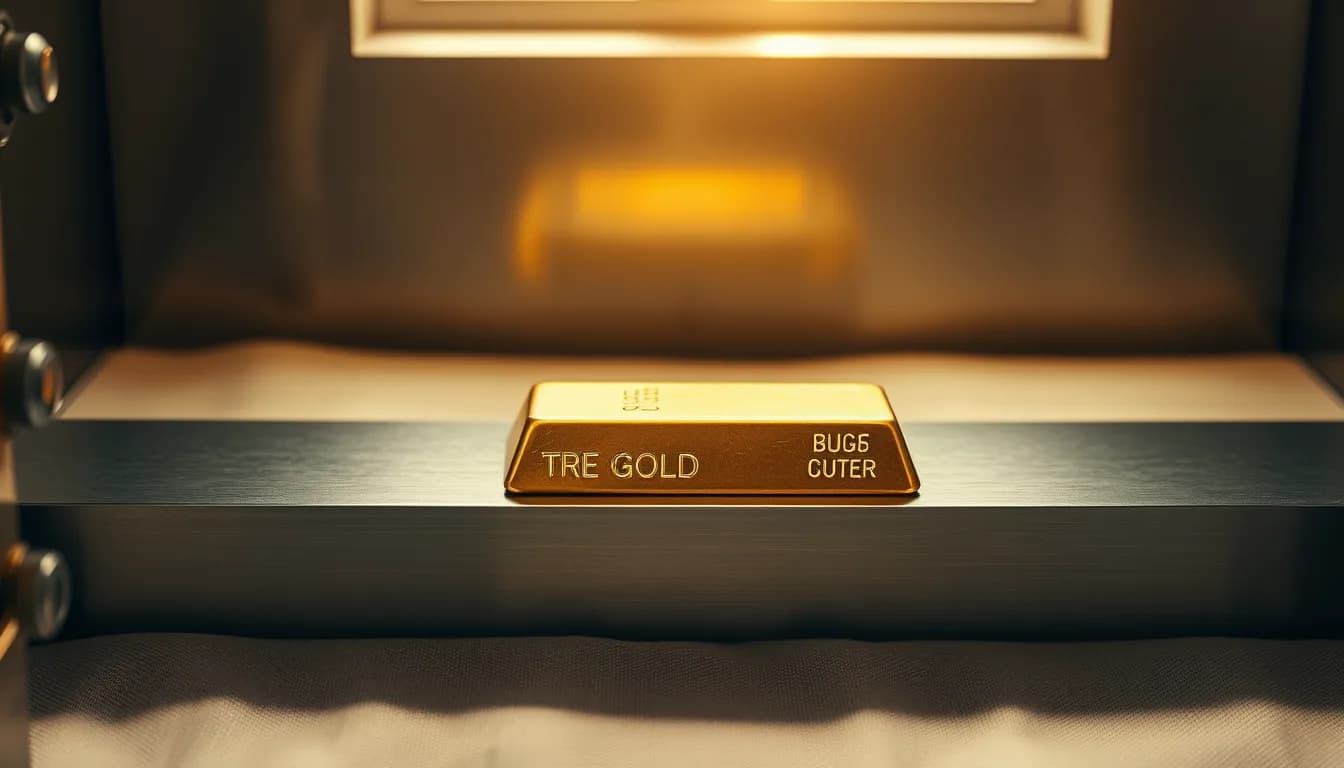
A 400 oz gold bar is a London Good Delivery bar weighing 350–430 troy ounces at 99.5%+ purity, and it's worth its fine-gold weight times spot, about 400 × {{gold_oz}}. You can legally own one in the US, but buying, storing and reselling it works very differently from buying coins.
A 400 oz gold bar is the gold that central banks, big vaults and gold ETFs actually hold. It's often called a "London Good Delivery" bar. It weighs about 12.4 kilograms (roughly 27 pounds) and holds around 400 troy ounces of gold, so it costs about 400 × $3,879.36. That's seven figures at current prices.
Private buyers can own one. Before you wire that kind of money, though, you need to know how these bars are priced, what they really cost, and why selling one is trickier than selling a stack of coins.
What a 400 oz gold bar actually is
The "400 oz" name is approximate. These bars are made to the London Bullion Market Association (LBMA) Good Delivery standard, which is the wholesale spec the global gold market trades on. A bar qualifies when it meets all of these:
- Weight: 350 to 430 troy ounces of gross weight. Most land close to 400 oz.
- Purity: at least 99.5% fine (995.0). Many are 999.9.
- Maker: cast by a refiner on the LBMA Good Delivery List, such as PAMP, Valcambi, Asahi, Umicore or Perth Mint.
- Markings: a serial number, the refiner's stamp, the fineness and the year of manufacture.
The bars are cast, not minted. They have a slightly rough, trapezoid shape, wider on top than on the bottom. A typical one is about 10 inches long, 3 inches wide and 1.5 inches tall. It looks small in photos, but it's surprisingly heavy in the hand.
| Spec | Typical 400 oz Good Delivery bar |
|---|---|
| Gross weight range | 350–430 troy oz (10.9–13.4 kg) |
| Typical weight | ~400 troy oz ≈ 12.44 kg ≈ 27.4 lb |
| Minimum purity | 99.5% (995.0) |
| Approx. size | ~10 × 3 × 1.5 inches, trapezoid |
| Approx. melt value | Fine oz × $3,879.36 (≈ 400 × $3,879.36) |
| Who holds most of them | Central banks, bullion banks, ETF vaults |
How a 400 oz bar is priced (it's not a fixed price)
No two Good Delivery bars weigh exactly the same, so dealers don't quote a flat "bar price." They price the fine gold content of the specific bar:
- Gross weight. The bar's actual weight, recorded to the nearest 0.025 troy oz.
- Fineness. The purity stamped on the bar, such as 999.5.
- Fine weight. Gross weight × fineness.
- Price. Fine weight × spot, plus or minus the dealer's premium.
Worked example: a bar with a gross weight of 401.150 oz at 999.5 fineness contains 401.150 × 0.9995 = 400.95 fine ounces. At spot, that's 400.95 × $3,879.36.
This is why the price you see quoted online changes from bar to bar. A 388 oz bar and a 412 oz bar are both "400 oz bars," but the 412 oz bar costs about 6% more. Always ask for the serial number, gross weight and fineness, and check the math yourself against the live gold price today.
For perspective, a 400 oz bar holds about the same gold as 12.4 one-kilo bars, or 400 one-ounce coins. Our gold bar value guide shows the live price for every common size.
What you'll really pay: premiums and hidden costs
Large bars carry some of the lowest premiums per ounce in the bullion world. On a 1 oz coin, a dealer may add several percent over spot. On a 400 oz bar, the markup is often a fraction of a percent up to around 1–2%. Even so, the extra dollars add up fast at this size.
| Cost item | What to expect |
|---|---|
| Dealer premium | Often ~0.5%–2% over spot. Ask for a per-fine-ounce quote. |
| Payment | Bank wire is standard. Few dealers take cards or checks at this size. |
| Shipping and insurance | Armored transport or registered insured shipping. Can run hundreds to thousands of dollars. |
| Storage (if vaulted) | Usually a small annual percentage of value, billed by the depository. |
| Sales tax | Depends on your state. Many states exempt bullion, but not all. Check before you buy. |
| Exit costs | Possible re-assay fee and a wider discount if the bar has left the vault system. |
Quick math on the premium: at about 400 × $3,879.36, every 1% of premium is roughly 4 × $3,879.36. That's about four ounces of gold. So shopping around between two dealers for half a percent is real money, not pocket change.
Where to buy a 400 oz gold bar in the US
Your local coin shop will not have one in the case. Your realistic options are:
- Large online bullion dealers. Several US and international dealers list Good Delivery bars, usually by special order. Some offer "buy and store," where the bar stays in their partner vault in your name.
- Bullion banks and private banks. These are mostly for institutional or high-net-worth clients, often with minimums.
- Refiner-direct channels. Refiners like PAMP make these bars, but they usually sell through distributors rather than to individuals.
Before you wire anything, check every one of these:
- The dealer has a long track record, a verifiable physical address and real reviews.
- You get a written quote with the serial number, refiner, gross weight, fineness and fine weight.
- You know whether the bar ships to you or stays in a vault, and who holds title. You want "allocated" or "segregated" storage in your name, not an unallocated IOU.
- Delivery, insurance and storage fees appear in writing.
- You've confirmed the wire instructions by phone, using a number you found yourself. Wire fraud targeting large gold buys is real.
Our guide to where to buy gold bars compares dealers, banks and warehouse clubs if you're weighing smaller sizes too.
The "chain of integrity" problem: why storage matters for resale
This is the part most product pages skip.
Inside the professional market, Good Delivery bars move between approved vaults under a documented chain of integrity. Big buyers trust a bar because they know it never left trusted hands. Once you take the bar home, that chain is broken.
The bar is still gold, and it's still worth melt. But a large buyer may want it re-assayed at an accredited refiner before paying full price. That costs money and takes time, and some buyers will offer a wider discount instead.
That gives you two practical paths:
- Keep it vaulted. This means lower resale friction and professional insurance. The trade-off is that you pay storage fees and don't hold it yourself.
- Take delivery. You get full control. You then pay for transport, insurance and a serious safe, and you likely face assay costs and a bigger haircut when you sell.
A 27-pound bar is also hard to hide and very easy to steal. Homeowner's policies often cap coverage for precious metals at a low amount, so ask your insurer about a separate rider before the bar shows up.
Selling a 400 oz gold bar: who actually buys them
A pawn shop or jewelry buyer can't write a check for this, and you shouldn't let one try. The realistic buyers are:
- The dealer you bought from. Many will quote a buyback, especially if the bar stayed in their vault.
- Large national bullion dealers with wholesale desks.
- Refiners, particularly if the bar needs re-assay anyway.
- Bullion banks, for larger or institutional sellers.
Recognized bullion generally sells back near spot, often 97–100%+ of it. A vaulted Good Delivery bar with its chain of integrity intact should sit at the strong end of that range. A home-stored bar from an unknown history may come in lower once assay costs are factored in.
Get at least two written bids on the same day. Make sure each bid is on a per-fine-ounce basis, so you can compare them directly. The same rules from our how to sell gold guide apply, just with more zeros.
Is it legal to own one? Taxes and paperwork
Legal: Yes. Private ownership of gold bullion has been legal in the US since the end of 1974. No federal law limits how much gold you can own.
Federal tax: The IRS treats physical gold as a collectible. Gains held longer than a year are taxed at up to 28% federally, not the lower long-term capital gains rates that apply to stocks. Short-term gains are taxed as ordinary income. On a seven-figure bar, even a modest price move creates a meaningful tax bill. Keep your purchase invoice forever.
Reporting:
- When you sell, dealers generally report large gold bar sales to the IRS on Form 1099-B. A 400 oz bar is well above the size that triggers broker reporting.
- If you pay with more than $10,000 in cash, or certain cash equivalents, the dealer must file Form 8300. A bank wire doesn't trigger 8300, but the bank keeps its own records. This is routine paperwork, not a red flag. Anyone offering to help you "avoid the paperwork" is the red flag.
Ask a tax professional before you buy at this size, especially about state taxes and estate planning.
400 oz bar vs. smaller bars vs. ETFs
For most people, the real question isn't "which 400 oz bar?" It's whether a 400 oz bar is the right tool at all.
| Option | Premium | Ease of selling | Storage | Notes |
|---|---|---|---|---|
| 400 oz Good Delivery bar | Lowest per oz | Need a big buyer; may need assay | Vault strongly preferred | All-or-nothing: you can't sell part of it |
| 1 kilo bars (32.15 oz) | Low | Many dealers buy them | Home safe or vault | ~12 kilos equal one 400 oz bar |
| 1 oz coins and bars | Higher | Sells almost anywhere | Easy | Most flexible |
| Gold ETFs | Annual fee, no premium | Sell in seconds | None | Many ETFs hold Good Delivery bars in vaults |
The big drawback of a 400 oz bar is that it's indivisible. If you need 10% of your money, you can't saw off a corner. Twelve kilo bars give you almost the same low premium while letting you sell in pieces. Check the live 1 kilo gold bar price to compare.
If you mainly want price exposure, a gold ETF often holds these exact bars on your behalf. It comes with an annual fee and counterparty considerations instead of storage and assay worries. Our gold ETF guide explains how they work and how they're taxed.
Gold also swings. Look at gold price history before you put a large lump sum into one asset at one moment.
The bottom line
A 400 oz gold bar is the wholesale standard of the gold world. It's priced by its exact fine-ounce weight, roughly 400 × $3,879.36, and it carries the lowest per-ounce premiums you'll find.
It's legal to own. But it's built for vaults, not for living rooms. Storage choices affect resale, buyers are few, you can't sell part of it, and gains face the 28% collectibles rate.
If you buy one, get a serial-specific written quote, keep it in allocated storage in your name, and verify every wire. If you want flexibility, kilo bars or an ETF may get you most of the benefit with fewer headaches.
Sources
Frequently asked questions
How much is a 400 oz gold bar worth?
It's worth its fine-gold weight times spot, about 400 × {{gold_oz}} for a typical bar. Exact value depends on the bar's actual weight (350–430 oz) and purity.
How much does a 400 oz gold bar weigh?
A typical 400 oz bar weighs about 12.44 kg, or roughly 27.4 pounds. Good Delivery rules allow anywhere from 350 to 430 troy ounces.
Can a private individual buy a 400 oz gold bar?
Yes. It's fully legal in the US, and some large bullion dealers sell them, usually by special order and paid by bank wire. Many buyers keep them in an allocated vault rather than at home.
Is a 400 oz gold bar pure 24K gold?
Good Delivery bars must be at least 99.5% fine, and many are 99.99%. Pricing is based on the actual fineness stamped on the bar, not an assumed 100%.
Who buys 400 oz gold bars?
Large bullion dealers, refiners and bullion banks. Bars that stayed in an approved vault are easiest to sell, while home-stored bars may need re-assay first.
How are 400 oz gold bars taxed?
Gains on physical gold held over a year are taxed as collectibles at up to 28% federally. Sales of large bars are generally reported by the dealer on Form 1099-B.
Get the gold brief
Gold's move and the reason behind it, in your inbox every US trading morning. Free, two minutes to read, unsubscribe anytime.
 AIJake · AI buying & selling guideJake is one of GoldTrack USA's AI writers. Figures are checked automatically against live market data, and sources are listed above. Not financial advice.

