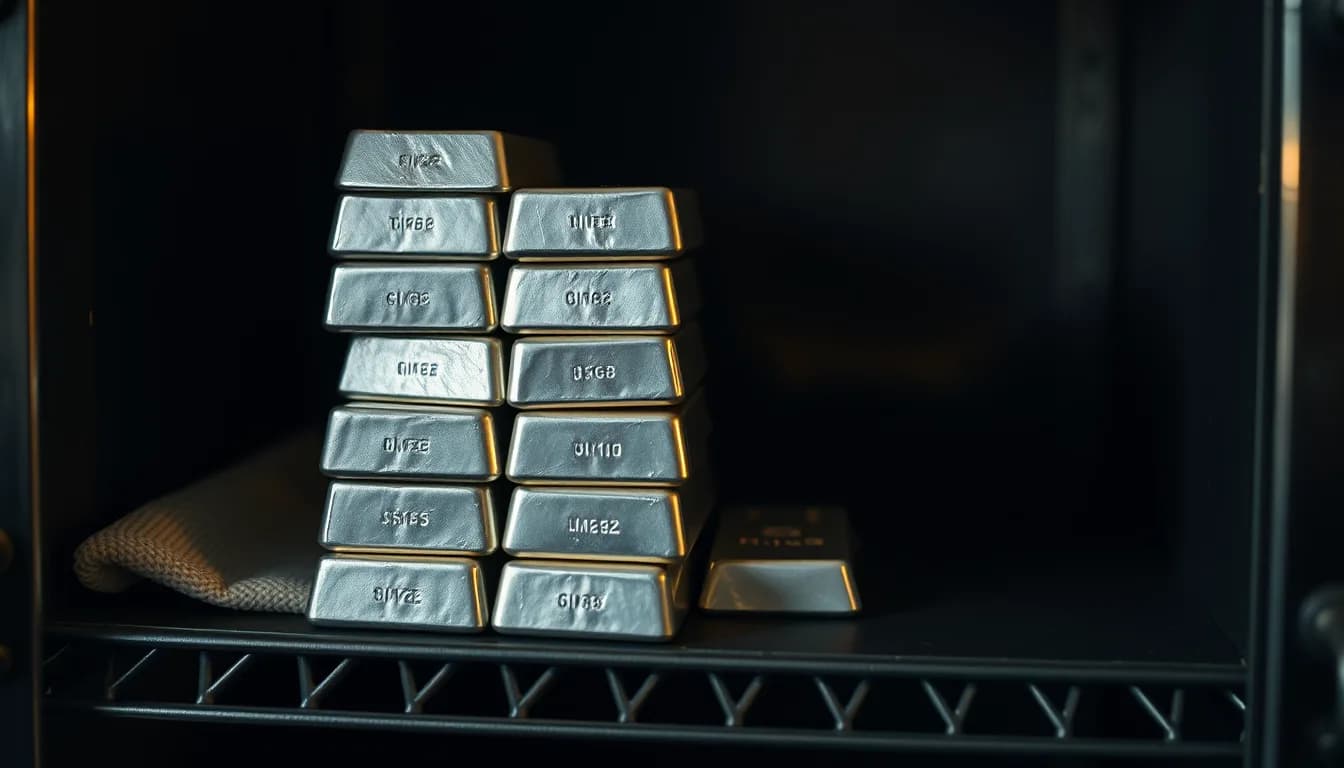
SLV is the ticker for the iShares Silver Trust, an exchange-traded trust that holds physical silver bars. Each share represents a little over 0.9 oz of silver, so its price tracks the silver spot price ({{silver_oz}}/oz) minus a 0.50% yearly fee. It pays no dividends, and long-term gains are taxed as collectibles at up to 28%.
SLV is the most heavily traded way to own silver in a brokerage account. Despite the "stock" label on every quote page, it isn't a company. It owns no mines, has no earnings and pays no dividends. It is a trust that holds silver bars in a vault and issues shares against them.
One fact explains most of what SLV does: each share represents a little over 0.9 troy ounces of silver, and that amount shrinks by about 0.5% a year. Silver is at $49.76 an ounce right now (live silver price). SLV's share price is roughly that number times the ounces per share.
What SLV actually is
| Detail | SLV |
|---|---|
| Full name | iShares Silver Trust |
| Sponsor | iShares (BlackRock) |
| Exchange | NYSE Arca |
| Launched | April 2006 |
| What it holds | Physical silver bars (London Good Delivery, about 1,000 oz each) held by a custodian bank |
| Sponsor fee | 0.50% per year |
| Dividends | None |
| Legal structure | Grantor trust, not a mutual fund or 1940 Act ETF |
| Tax on long-term gains | Collectibles rate, up to 28% federal |
| Silver per share | Roughly 0.9 oz, falling slowly each year |
When you buy SLV, you own a fractional claim on the silver in the trust. You can't take delivery of it. Ordinary shareholders can only sell their shares on the market. Large institutions called authorized participants create and redeem shares in big blocks, and that arbitrage keeps the share price closely tied to the value of the metal.
How SLV's price is set
The formula is simple:
SLV share price ≈ silver spot price × ounces of silver per share
When SLV split 10-for-1 in 2008, one share represented about 1 ounce. Since then the trust has sold a small slice of silver every day to pay its 0.50% fee. After roughly 18 years of that, each share holds about 0.91 oz. iShares publishes the exact "ounces per share" figure daily on the fund page.
Worked example: at 0.91 oz per share, one SLV share is worth about 0.91 × $49.76. That's why SLV always trades somewhat below the price of a full ounce of silver. The gap is the accumulated fee, not a discount you can capture.
A few other quirks show up on quote pages:
- P/E ratio. Some sites display one for SLV. Ignore it. A silver trust has no earnings, so the figure is a data artifact.
- "Market cap." For SLV this effectively means the total value of silver in the trust. It tells you size and liquidity, not company value.
- Opening gaps. Silver trades almost around the clock, but SLV trades during U.S. market hours plus limited extended sessions. If silver moves overnight in London or Asia, SLV often opens with a jump.
- NAV vs. price. The two normally sit within pennies of each other. A large gap on a data page usually means stale data, not a real bargain.
What SLV costs to hold
The 0.50% fee doesn't show up as a bill. It shows up as slightly less silver per share each year. Here's what it means in dollars, assuming silver's price stays flat:
| Amount invested | 1 year | 5 years | 10 years |
|---|---|---|---|
| $10,000 in SLV (0.50%) | ~$50 | ~$250 | ~$490 |
| $10,000 in SIVR (0.30%) | ~$30 | ~$150 | ~$300 |
| $10,000 in physical silver | $0 fee, but you pay a dealer premium when you buy, a spread when you sell, plus storage and insurance |
SLV's real advantage is liquidity. Millions of shares trade daily and the bid-ask spread is usually a penny, so getting in and out costs almost nothing. For buy-and-hold investors, the cheaper alternatives are worth a look. For active traders and options users, SLV's liquidity is hard to beat.
SLV vs. the alternatives
| Option | What you own | Approx. annual cost | Tracks silver price? | Tax on long-term gains | Typical user |
|---|---|---|---|---|---|
| SLV (iShares Silver Trust) | Share of vaulted silver | 0.50% | Closely | Collectibles, up to 28% | Traders, options users, large positions |
| SIVR (abrdn Physical Silver Shares) | Share of vaulted silver | 0.30% | Closely | Collectibles, up to 28% | Cost-conscious long-term holders |
| PSLV (Sprott Physical Silver Trust) | Units of a Canadian closed-end trust holding silver | Roughly 0.6% | Yes, but can trade at a premium or discount to its silver value | Can differ: PFIC rules with a QEF election may allow regular capital-gains rates (check with a tax pro) | Holders who care about the tax angle or the trust's redemption-for-metal feature |
| Physical coins and bars | Metal in your hand | No fee; premiums and storage instead | Yes, minus buy/sell spreads | Collectibles, up to 28% | People who want no counterparty |
| Silver miner ETFs (e.g., SIL) | Mining company stocks | About 0.65% | Loosely, with extra swings | Ordinary stock rates | Investors wanting leverage to silver plus business risk |
| Leveraged funds (e.g., AGQ) | Futures and swaps aiming for 2× daily returns | About 1% | Only day to day; drifts over time | Partnership K-1 rules | Short-term traders only |
SLV and SIVR are close substitutes. The main differences are the fee and liquidity. SLV is far bigger and has a deep options market. SIVR is cheaper to hold.
How SLV is taxed
This is where many buyers get surprised. Because SLV is a grantor trust holding physical metal, the IRS treats your shares like owning the silver itself.
- Held one year or less: gains are taxed as ordinary income.
- Held more than one year: gains are taxed at the collectibles rate, up to 28% federally. A regular stock or stock fund would top out at 20%.
- High earners may also owe the 3.8% net investment income tax.
- The fee sales. Each time the trust sells silver to pay expenses, shareholders technically have a tiny taxable sale. Your broker provides the figures. The amounts are usually very small, but they exist.
- In an IRA or 401(k) brokerage window, none of this applies year to year. Traditional account withdrawals are taxed as ordinary income, and qualified Roth withdrawals are tax-free.
Gold works the same way. The gold ETF guide covers GLD and IAU, which follow identical tax rules. Holding SLV in an IRA is also much simpler than setting up a self-directed precious metals IRA. Our gold IRA guide explains the custodian and storage costs those involve.
SLV vs. owning physical silver
This is the real choice most silver buyers face.
SLV wins on:
- Cost to trade. A penny-wide spread beats the dealer markups on coins. Popular bullion coins like the American Silver Eagle often sell for several dollars an ounce over spot and buy back for less.
- No storage, insurance or theft risk.
- Selling in seconds at a live market price.
- Easy to hold in retirement accounts.
Physical wins on:
- No ongoing fee.
- No reliance on a trustee, custodian or broker.
- Something you can hold if financial plumbing breaks. This is the scenario some buyers care about most, and SLV can't help with it because you can't redeem shares for metal.
On the "paper silver" debate: SLV publishes a list of the bars it holds. Its prospectus says the trust doesn't lend out its silver. Your risks are custodian and operational risk, not a fractional-reserve scheme. Whether that's enough comfort is a personal call.
If you go the physical route, compare prices carefully. Our breakdowns of Costco silver bars and coins and silver coin melt values show what you're paying above metal value.
What moves SLV
SLV is silver, so it moves with the forces that drive silver:
- Interest rates and real yields. Silver pays no interest, so higher real yields make it less attractive. As of October 21, 2026, the 10-year TIPS real yield stood at 2.76%, high by the standards of the past decade.
- The U.S. dollar. Silver is priced in dollars. A stronger dollar is usually a headwind.
- Industrial demand. Roughly half of silver demand comes from industry: solar panels, electronics, EVs. Silver reacts to economic data in ways gold mostly doesn't.
- Gold. Silver tends to follow gold, with bigger swings in both directions. The gold-silver ratio, now 78.5, tracks how many ounces of silver equal one ounce of gold.
- Investor flows. When money pours into SLV, the trust buys silver. Heavy outflows mean it sells.
Volatility is the defining trait. The 52-week trading range for SLV quoted in late October 2026 ran from about $42 to about $110 per share, a peak-to-trough drop of more than 60%. Silver can lose half its value faster than most people expect.
How to buy SLV
- Open or use a brokerage account. Any major U.S. broker carries SLV, usually with $0 commission. Many also offer fractional shares.
- Choose the account. A taxable account means the collectibles tax applies when you sell at a gain. An IRA defers or avoids that.
- Search ticker SLV (NYSE Arca). Don't confuse it with silver miner funds or leveraged products.
- Use a limit order, ideally during regular hours (9:30 a.m. to 4 p.m. ET), when spreads are tightest.
- Size the position deliberately. Given silver's swings, decide in advance how much of your portfolio you're comfortable seeing move 30% or more in a year.
Who SLV tends to fit
This isn't advice. These are the trade-offs. SLV suits people who want silver price exposure with stock-like convenience, trade frequently, or use options. Long-term holders who never plan to trade may prefer a lower-fee fund like SIVR. People who want metal outside the financial system will only be satisfied with coins and bars, and they accept dealer spreads and storage as the price.
The bottom line
SLV is a vault of silver bars wrapped in a ticker symbol. Each share holds about 0.9 oz, and the price tracks spot silver ($49.76) minus a 0.50% annual fee. It's cheap to trade, easy to own and very liquid. It's also more expensive to hold than SIVR, impossible to redeem for metal as a retail investor, and taxed at collectibles rates up to 28%. Know those trade-offs, and respect silver's volatility, before you buy.
Sources
Frequently asked questions
Does SLV pay a dividend?
No. SLV holds only silver, which produces no income. The trust sells a small amount of silver each day to pay its 0.50% fee, so there's nothing left to distribute.
Is SLV backed by physical silver?
Yes. The iShares Silver Trust holds London Good Delivery silver bars in custody and publishes a bar list. Retail shareholders can't redeem shares for metal, though. Only large authorized participants create and redeem shares.
Why is SLV's price lower than the price of an ounce of silver?
Each share now represents roughly 0.91 oz of silver, not a full ounce, because the 0.50% annual fee has slowly reduced the silver per share since 2008. A share is worth about 0.91 × {{silver_oz}}.
How is SLV taxed?
Gains on shares held over a year are taxed as collectibles at up to 28% federally. Gains on shares held a year or less are taxed as ordinary income. Inside an IRA, those rules don't apply until withdrawal.
What's the difference between SLV and PSLV?
SLV is a U.S. grantor trust with a 0.50% fee that trades very close to its silver value. PSLV is a Canadian closed-end trust with a fee of roughly 0.6%. It can trade at a premium or discount to its silver, and its tax treatment can differ.
Is SLV a good substitute for silver coins?
For price exposure, yes, and it's cheaper to trade than coins with dealer premiums. It won't give you metal in hand or independence from banks and brokers, which is the main reason many people buy physical silver.
Get the gold brief
Gold's move and the reason behind it, in your inbox every US trading morning. Free, two minutes to read, unsubscribe anytime.
 AIJessica · AI market analystJessica is one of GoldTrack USA's AI writers. Figures are checked automatically against live market data, and sources are listed above. Not financial advice.

